
Showing Up Matters: A victory for Washington's immigrant communities
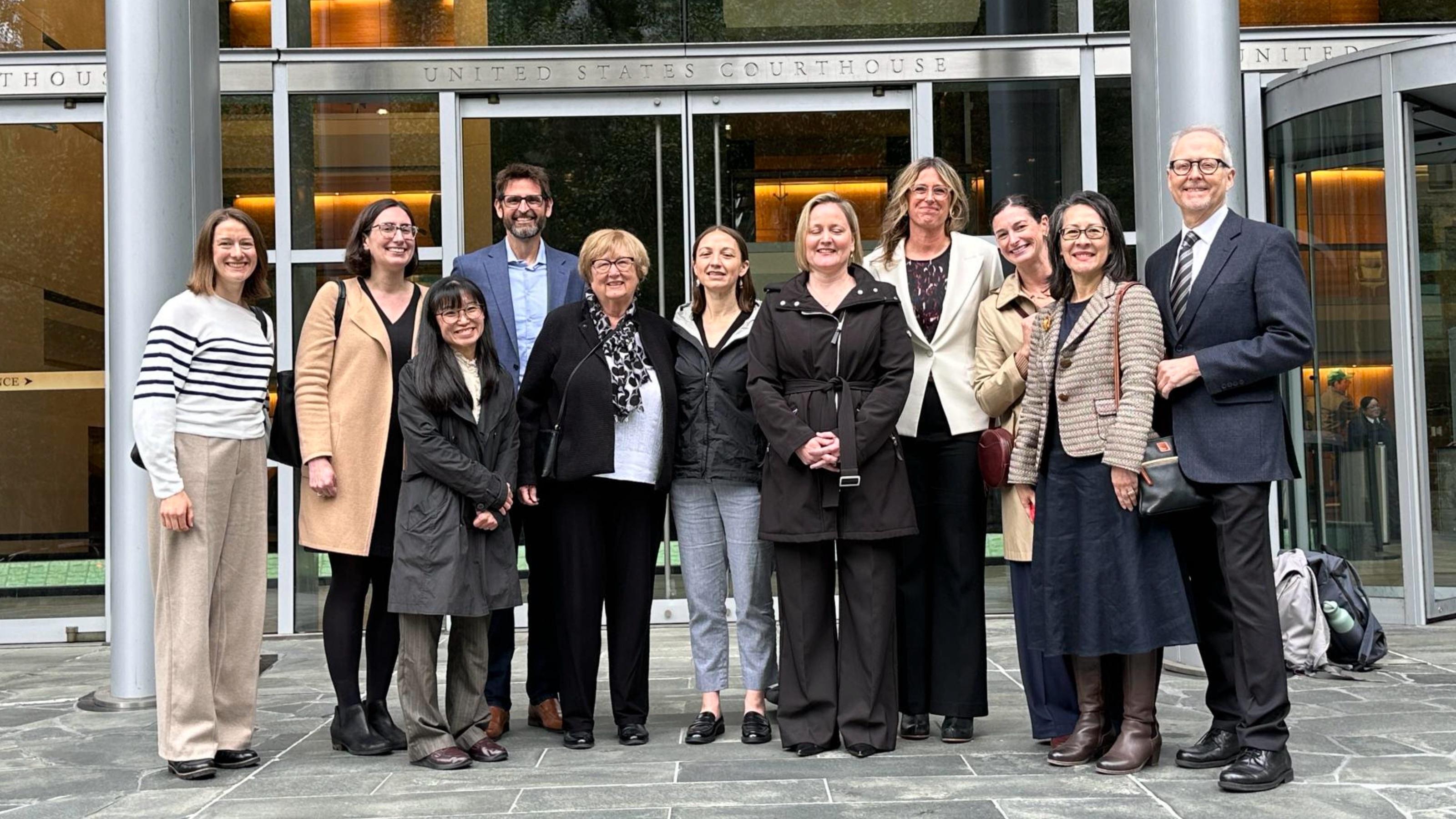
Image: Staff and supporters of Neighborhood House and Northwest Health Law Advocates outside the federal courthouse in Seattle on Sept. 29, 2026. (Photo: courtesy of Bruce Herbert)
By Nancy Miller Herbert, with Leif Utne
On Tuesday morning, Bruce and I walked into the federal courthouse in Seattle to support our longtime friends at Neighborhood House. Today, I am feeling something that has been in rather short supply lately: hope.
This is because U.S. District Judge Thomas Zilly granted a preliminary injunction that prevents the U.S. Department of Health and Human Services from terminating Medicaid funding for a particularly vulnerable group of Washington residents – qualified noncitizens who receive Supplemental Security Income (SSI) because they are elderly, blind, or living with disabilities.
The case was brought by Neighborhood House and one of its clients, Mariia Matsai, represented by Northwest Health Law Advocates (NoHLA) and Barnard Iglitzin & Lavitt. Mariia fled the war in Ukraine and came to the United States under humanitarian parole. She depends on Medicaid for medical care and 158 hours each month of assistance with daily living. Without that support, Judge Zilly found, she would lose help with food preparation, mobility and fall prevention, hygiene, medication management, and other essential needs.
She is far from alone. Neighborhood House learned in August that 150 of its SSI-recipient clients were scheduled to lose Medicaid-funded long-term care or daily-living assistance on October 1st as a result of HHS's interpretation of federal law.
Judge Zilly's order protects not only Neighborhood House's clients, but all qualified noncitizen SSI recipients throughout Washington State while the litigation proceeds.
Being in the courtroom was riveting – and I hadn't even had my morning cup of coffee.
For two solid hours, the attorneys and Judge Zilly moved quickly through statutory language, congressional intent, decades of law, and the very real consequences for people whose health and independence depend upon Medicaid. You had to track closely just to keep up.
Jennifer Robbins, lead attorney for the plaintiffs, was extraordinary. And I was particularly struck by Judge Zilly's preparation and his pointed questioning – it was clear there were particulars he was more familiar with than the lawyers who presented the briefs.
At one point, the discussion turned to whether Congress had actually amended or repealed the longstanding provision that guarantees Medicaid eligibility to qualified noncitizens receiving SSI. The judge asked the government's attorney how many times Congress had specifically used words such as “amend” and “repeal” in H.R. 1.
The attorney didn't know.
The judge did.
As Judge Zilly subsequently wrote in his 24-page order, H.R. 1 uses some form of “amend” 912 times and some form of “repeal” 39 times. Yet Congress never amended or repealed the provision of federal law guaranteeing Medicaid eligibility to the qualified noncitizen SSI recipients at issue in this case.
Judge Zilly opened his order with a memorable sentence:
What Congress hath giveth, an executive agency may not taketh away.
There is something else from Tuesday that I don't want to lose amid all the legal details.
We got to be there.
Ordinary members of the public can walk into a federal courthouse, sit quietly in the gallery, listen to the government's lawyers make their case, hear citizens and community organizations challenge the government, and watch a federal judge ask searching questions of all parties.
That openness is easy to take for granted. But sitting there, it didn't feel ordinary at all. It felt like something worth protecting – and participating in.
There were about a dozen of us there supporting the plaintiffs, Bruce and I among them. Three older women had come to hear the judge – his wife and two neighbors. On the government's side, there was only a single defense attorney.
As I joked afterward, if we could have settled the matter with dodgeball, our side would have been looking pretty good.
Of course, this case is far more serious than that. HHS argued that the 2025 federal legislation changed which noncitizens could receive federally funded Medicaid and that the challenged guidance properly implemented Congress's intent. Judge Zilly disagreed at this preliminary stage. He found that the plaintiffs had established a likelihood of success on their Administrative Procedure Act claims – or, at minimum, raised serious questions going to their merits – and had also established a likelihood of irreparable harm without an injunction.
The litigation itself is not over. This is a preliminary injunction, not a final judgment on the case.
And this victory should not obscure a painful reality. Separate provisions of H.R. 1 will cause other lawfully present immigrants in Washington to lose benefits such as WA Apple Health coverage. NoHLA estimates that approximately 14,000 Washington residents will lose coverage on October 1 as a result of of those broader statutory changes.
For Bruce and me, supporting Neighborhood House over the years means more than supporting an institution. Founded in 1906, Neighborhood House has spent 120 years serving people in this community, with a particular focus on low-income community members, immigrants, refugees, and public-housing residents.
Its work represents a simple but powerful idea: our neighbors deserve dignity, opportunity, and care – especially when they confront circumstances that cannot be navigated alone.
This week, that mission brought Neighborhood House into a federal courtroom – in a way that could set a precedent nationwide.
Today, a number of Washington's most vulnerable residents still have their healthcare because Neighborhood House, Mariia Matsai, NoHLA, their attorneys, and many others were willing to stand up and insist that the law be followed.
The case continues. There will undoubtedly be more arguments, more legal briefs, and more work ahead.
But today is a day to celebrate.
And Tuesday was a wonderful reminder that showing up matters.
Note: This material is intended for educational purposes only. As with all our public writing, blog posts do not constitute tax or financial planning advice; likewise, they are neither an offer to sell nor solicitation to buy any investment or security.
