
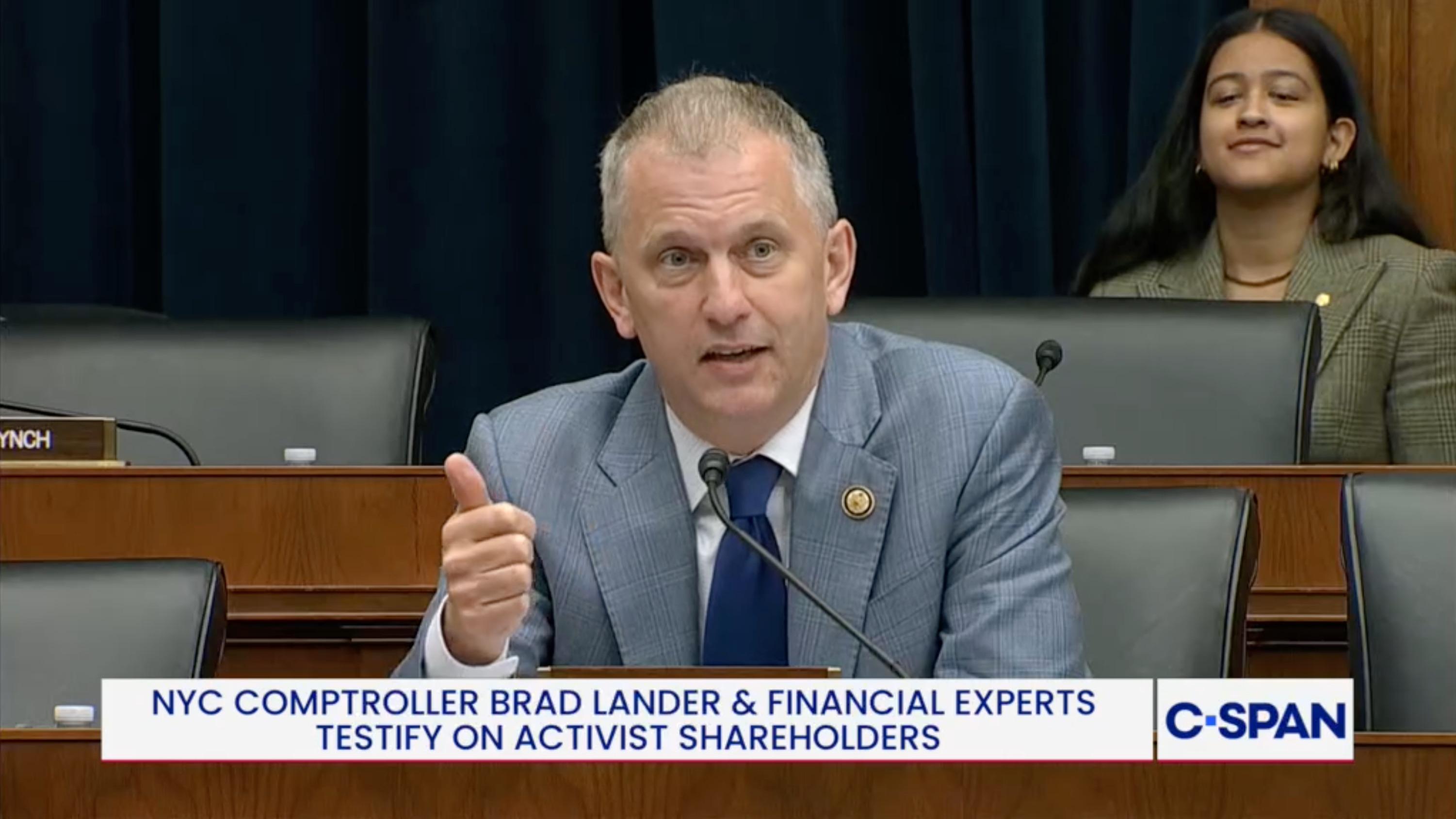
Rep. Casten Skewers corporate ESG critics
During a fiery House Financial Services Committee Hearing on Wednesday, Rep. Sean Casten (D-IL) offered a masterclass in how to counter right-wing messaging attacking ESG investing and shareholder democracy. In the clip below, nearly two hours into the hearing, Rep. Casten calls the entire meeting "dumb", then brilliantly skewers the arguments of the three corporate witnesses. It's well worth five minutes of your time.
The hearing, titled "Proxy Power and Proposal Abuse: Reforming Rule 14a-8 to Protect Shareholder Value" was organized by the committee's Republican majority to air arguments for a package of fourteen anti-ESG bills, and featured four expert witnesses: James Copland, a senior fellow at the right-wing Manhattan Institute; two oil industry attorneys, Ferrell Keel, partner and Jones Day, and Ron Mueller, partner at Gibson Dunn & Crutcher; as well as NYC Comptroller Brad Lander.
In their testimony, the think-tank fellow and the corporate lawyers offered a familiar litany of grievances against shareholder democracy, painting corporate boards and CEOs as conscientious stewards of shareholder value who should not have to waste their time responding to the pesky concerns of small investors who don't have "skin in the game." They argued that ESG investors are abusing the proxy process to push narrow activist agendas that have nothing to do with running their companies.
The corporate witnesses argued further that proxy advisory firms, which provide recommendations to institutional investors on how to vote their shares on corporate proxy ballots, exert undue influence on Wall Street. Several Republican committee members even warned that the two main proxy advisors, ISS and Glass-Lewis, could be pushing "European ideas" like climate-risk disclosure, workforce diversity, and human rights on unsuspecting American pensioners who don't share such "woke" concerns. ISS is owned by the German stock exchange. Glass-Lewis is owned by a Canadian private-equity firm.
Mr. Lander, who manages the retirement funds of over 700,000 current and former New York City employees, countered these arguments with a full-throated defense of shareholder rights, pointing out that small investors have often used proxy resolutions to raise many issues and ideas that have later become standard practices in good corporate governance – ideas like having independent board members, or shareholder review of executive compensation.
Several other Democrats pushed back strongly against the majority's arguments, including ranking member Maxine Waters (CA), Ayanna Presley (MA), Rashida Tlaib (MI), and Bill Foster (IL). But Rep. Casten's segment was the highlight, truly a masterclass in how to defend ESG and shareholder rights from corporate attacks. Watch and learn.
