
Jesse Jackson: A Pioneer for Corporate Accountability
The Rev. Jesse Louis Jackson Sr., who passed away Feb. 17th 2026 at the age of 84, is rightly remembered as one of the towering figures of the American civil rights movement. But within the world of responsible investment and shareholder advocacy, he holds a special place – as a visionary who understood, decades before it became mainstream practice, that the boardroom was a battleground for justice just as surely as the courthouse or the ballot box.
Jackson's engagement with corporate America grew directly out of his roots in the economic wing of the civil rights movement. As the head of Operation PUSH – People United to Save Humanity – in Chicago from 1971 onward, he perfected a model of economic leverage that would influence activist investors for generations: identifying corporations that profited from Black consumers while failing to hire, promote, or contract with Black workers, and then applying sustained public pressure until change came. In 1981, the Coca-Cola Company became the first corporation to sign an agreement to increase business with African American vendors and expand management opportunities for Black people. Similar agreements followed with Kentucky Fried Chicken, Anheuser-Busch, Seven-Up, and Burger King. Jackson demonstrated that consumer and investor power, wielded together, could move even the most entrenched corporate interests.
When the South Africa divestment movement gathered force in the 1980s, Jackson became one of its most compelling national voices. He spoke at rallies on campuses across the country – including a landmark gathering of five thousand students at Harvard Yard in April 1985 – calling on universities and institutional investors to withdraw their holdings from companies doing business with the apartheid regime. He understood intuitively what would later become a core principle of ESG investing: that capital is not neutral, and that where money flows, moral responsibility should follow. His advocacy helped build the political and public pressure that led to the eventual collapse of the apartheid government. It is worth noting that the formal shareholder resolution mechanism in that era was pioneered by faith-based institutions – the Episcopal Church filed the first shareholder resolution with General Motors on South Africa in the early 1970s – and Jackson's moral voice helped amplify that movement.

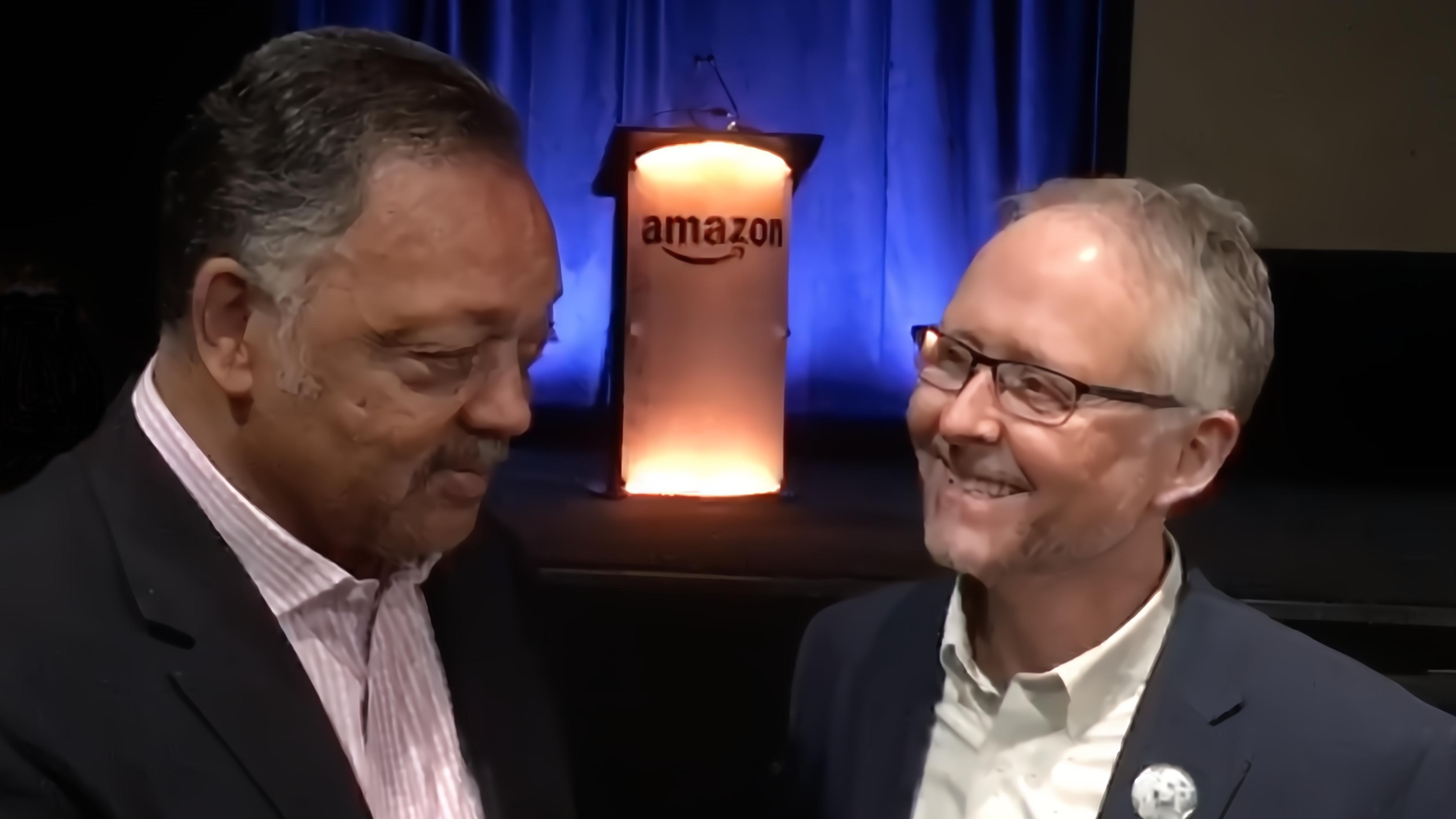
Rev. Jesse Jackson presented a shareholder proposal calling for greater diversity in the boardroom at Amazon’s 2018 annual meeting. (Photo: Bruce Herbert, Newground Social Investment)
As the shareholder advocacy movement matured into a formal discipline, he adapted with it. Through the Rainbow PUSH Coalition, he began showing up not just at rallies but at annual meetings – proxy in hand – pressing the case for racial and gender diversity in corporate boardrooms and executive suites. In 2014 he opened a Rainbow PUSH office in Silicon Valley and attended the shareholder meetings of Google, eBay, and Facebook, arguing that the tech industry's notorious diversity gaps were not just a social failing but a governance failure. At Google's meeting, his pressure contributed to the company reversing course and publicly releasing its workforce diversity data for the first time – a disclosure that triggered a wave of similar EEO-1 transparency disclosures across the industry.
At Amazon's 2018 annual meeting in Seattle, Jackson brought that message directly to one of the most powerful companies on earth. In person, while making clear that more remained to be done, he thanked CEO Jeff Bezos for Amazon's adoption of a new policy which required the board to consider diverse candidates – including women and minorities – for all director openings. "Amazon has an all-white board", he noted, continuing that the company should open up its board to new ideas, “to make it look like America.” It was a characteristically direct formulation: moral clarity expressed with minimal words.
In his later years, as Parkinson's disease gradually eroded his mobility, Jackson continued to attend shareholder meetings and press for greater equity in hiring, board composition, and economic opportunity. He never stopped believing that shareholders – even small ones – had both the power and the obligation to hold corporations accountable.
The world of responsible investing has become far more sophisticated since Jesse Jackson first began connecting economic power to social justice. There are now hundreds of high-conviction ESG funds and dedicated shareholder advocates, as well as a robust regulatory framework for shareholder proposals. That progress has not gone uncontested: in recent years, a determined backlash from conservative politicians, state legislators, and some mainline institutional investors has sought to roll back ESG commitments, frame shareholder advocacy as ideological overreach, and pressure asset managers to retreat from diversity and climate-related engagement.
It is a backlash Jackson would have recognized instantly – the same argument, in new clothes, that corporations have no business concerning themselves with racial equity or social justice. He spent fifty years proving otherwise. The movement he helped build will need that same persistence to flourish in the years ahead.Jesse Jackson was, in the truest sense, a forefather of the field. May he rest in power.
~ ~ ~
Speaking to local media outside Amazon's 2018 annual meeting, Rev. Jesse Jackson calls on the company to improve its treatment of contract workers. (Video: Leif Utne, Newground Social Investment)
